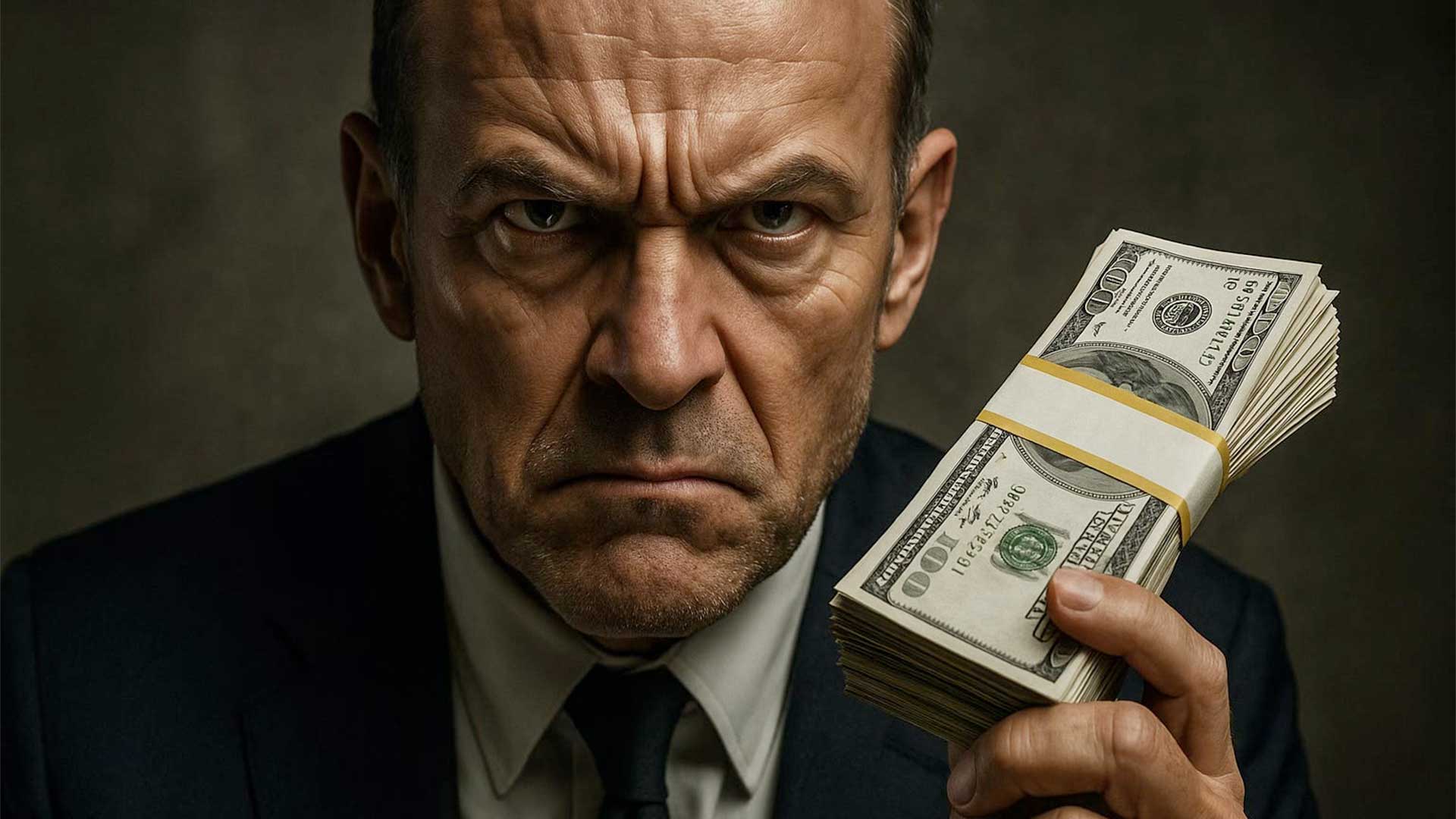
In the weeks before Andrew Cuomo’s mayoral dream went up in smoke on election night, a handful of independent spending groups backed by New York City’s oligarchy spent more than $55 million supporting the ex-governor or attacking his ultimately victorious rival, Assemblymember Zohran Mamdani.
With Cuomo garnering just under 855,000 votes, that amounted to the would-be power brokers spending $65 per vote for a losing candidate.
Meanwhile, independent committees that included backers such as the Working Families Party dropped a relatively paltry $16 million to either support Mamdani or go after Cuomo. Mamdani snagged a little more than 1 million votes, making their investment come in at $15.81 per vote.
For a winner.
And in the final weeks of the general election, one of the groups backing Cuomo unleashed a high-voltage ad featuring a photo of Mamdani placed over a an image of the burning World Trade Center, an ad that even some Cuomo supporters considered overtly Islamophobic and that some observers say may have actually backfired.
If anything, this bruising election raised questions about the effectiveness of such committees — which are not permitted to coordinate with candidates and are not bound by the usual restrictions campaigns must adhere to — in swaying voters.
Authorized under the Supreme Court’s Citizens United decision, the committees are a workaround of sorts from the strict rules campaigns must follow.
Mayoral campaigns that wish to accept public matching funds are barred from accepting contributions from unions or corporations. Campaigns also can’t keep any donation from an individual totaling more than $2,100, and if the individual does business with the city, that cap shrinks to $400.
Because both Cuomo, 67, and Mamdani, 34, signed up for public matching funds, they lived by these restrictions which, in turn, limited how much their campaigns could ultimately spend — around $12 million each. The involvement of so many independent spending committees, particularly those pushing Cuomo, took the contest to a place where much more money played a role.
These committees are allowed to accept donations of unlimited amounts from individuals, and they can take checks directly from unions and corporations. In the case of those supporting Cuomo or opposing Mamdani, dozens of these donations topped $250,000, $500,000 — even $1 million. Michael Bloomberg, New York’s ultra-wealthy former mayor, made four donations to two pro-Cuomo groups that totaled $13.3 million.
Spending by these groups on municipal elections broke records this cycle, doubling from just over $40 million in 2021 to more than $81 million in 2025. They started spending to promote the former governor before the June Democratic primary, but then Mamdani beat Cuomo by a significant margin. The spending stopped briefly, until — undaunted by the sobering primary setback — the money started flowing again after Cuomo announced his quixotic bid to run as an independent in the general election.
Starting about three weeks ago, the big money spigot reopened. Real estate moguls, venture capitalists and other wealthy New Yorkers terrified by the prospect of a “socialist” City Hall began making jaw-dropping donations to groups with names such as Fix the City, For Our City and the apocalyptic Stop the Socialists. (Mamdani is a member of the Democratic Socialists of America.)
Fix the City ultimately spent the most: $18 million to support Cuomo and $11 million to oppose Mamdani. That included a $12.7 million spending spree over the last two weeks on videos, texts and robocalls highlighting Mamdani’s past (and repeated) calls to “defund the police” during the 2020 protests that erupted in response to the Minneapolis police murder of George Floyd. (Mamdani has since amended his position, stating that the NYPD plays an important role in public safety.)
But the ad that attracted the most blowback started popping up just last week. It was sponsored by For Our City, a group backed by major real estate developers and other wealthy New Yorkers, including Bloomberg, who contributed $3.5 million. (The former mayor also donated $9.8 million to Fix the City).
For Our City raised $8.1 million and spent $7.1 million, including $650,000 on a 15-second video ad that ran on Sunday before the election that set off alarm bells from both Cuomo and Mamdani supporters.
The ad opened with an image of a smiling Mamdani with the Twin Towers burning in the background. It then went on to highlight Mamdani’s hobnobbing with Hasan Piker, a left-leaning “influencer,” highlighting a clip of Piker stating in a past episode of his hugely popular podcast that America “deserved 9/11.”


Critics warned that attack ads like the Piker spot reject the notion of engaging in a nuanced, reasoned conversation over differences of policy and opinion, and instead fan the flames of hatred.
Veteran political consultant Hank Sheinkopf, who was hired by Save NYC, a separate anti-Mamdani independent group run by former Republican Lt. Gov. Betsy McCaughey, criticized the Twin Towers ad, stating that it “was probably hurtful to the cause because Mamdani was 9 years old when that happened. And it was seen as Islamophobic.”
Amy Spitalnick, CEO of the Jewish Council for Public Affairs, also dubbed the For Our City ad Islamophobic, arguing that it distracts from real concerns about Mamdani’s stated pro-Palestinian causes and his refusal to recognize Israel as a Jewish state.
“There are real legitimate concerns about a variety of issues, including comments Mamdani has made about policies,” she told THE CITY. “That doesn’t mean an Islamophobic bigoted attack ad is acceptable — that’s gotten lost in this discussion.”
Spitalnick, who once served as a spokesperson for former Mayor Bill de Blasio, noted that the September 11 attacks have “been used as a tool to smear the Muslim community.”
“We know where that’s led in terms of hate crimes, in terms of the rollback of rights,” she said. “And the use of 9/11 is offensive at best and deeply dangerous in so many ways.
“There are ways to disagree with a candidate’s approaches without bigoted tropes,” she added.
Sheinkopf contends some opposition messages funded by the pro-Cuomo independent spending committees accomplished their goal and had a real effect on turnout.
The group he worked for, Save NYC, focused on canvassing neighborhoods in Queens and the Bronx where Cuomo wound up doing well.
Sheinkopf also praised as effective another ad put up by For Our City which depicted empty subway stations late at night, with a narrator stating, “The biggest fear is when you’re alone.”
With ominous music pulsing in the background, the narrator in that ad criticizes Mamdani’s plan to have health clinicians — not the police — respond to 911 calls about people experiencing a mental health crisis.
“The negative ads on Mamdani that were clever, the subway ad for instance, worked,” Sheinkopf said. “Most effective ads are those that touch people. Those ads touch people.”