President Donald Trump’s congressional gerrymander sailed through the Missouri legislature in September, but the GOP plan to flip one of the state’s eight districts is far from a done deal.
A state court held a trial Wednesday on the question of whether the Missouri Constitution prohibits mid-decade redistricting after a group of voters filed a lawsuit challenging the plan. It’s one of numerous legal challenges that the Republican gerrymander will need to survive — as well as a proposed ballot referendum that could give voters the final say.
Together with Texas and North Carolina, Missouri is one of three states that have redrawn maps this year expressly to help Trump win more congressional seats in the 2026 election. Voters are taking the gerrymanders to court in all three states. Texans are now awaiting a ruling on their map, while a North Carolina district court is set to hold a hearing next week.
In Missouri, three separate lawsuits argue that the state prohibits mid-decade redistricting.
“The Missouri Constitution makes it very clear that redistricting shall be done when the state of Missouri gets new census figures…and they’re not allowed to do it again until they get new census data,” the plaintiffs’ attorney, Chuck Hatfield, told Democracy Docket after Wednesday’s trial.
Regardless of the outcome, an appeal is expected.
“We all know that this case will [ultimately] be decided by the Missouri Supreme Court,” Hatfield said.
The Missouri Supreme Court is made up of five justices appointed by Republicans and two appointed by Democrats. Hatfield expects that the court could take up the case in January or February.
In a brief, the plaintiffs argued that the Missouri Supreme Court ruled in 2012 that redistricting can “occur only immediately following the certification of the census and cannot occur again until a subsequent census is certified.”
But the Missouri Republican State Committee, an intervenor in the case, contends that nothing in the state constitution expressly prohibits mid-decade redistricting.
A GOP attorney also argued Wednesday that the legislature has exclusive power to enact redistricting plans and the state court cannot set aside the map it passed, Hatfield said. That fringe legal doctrine is known as “independent legislature theory.”
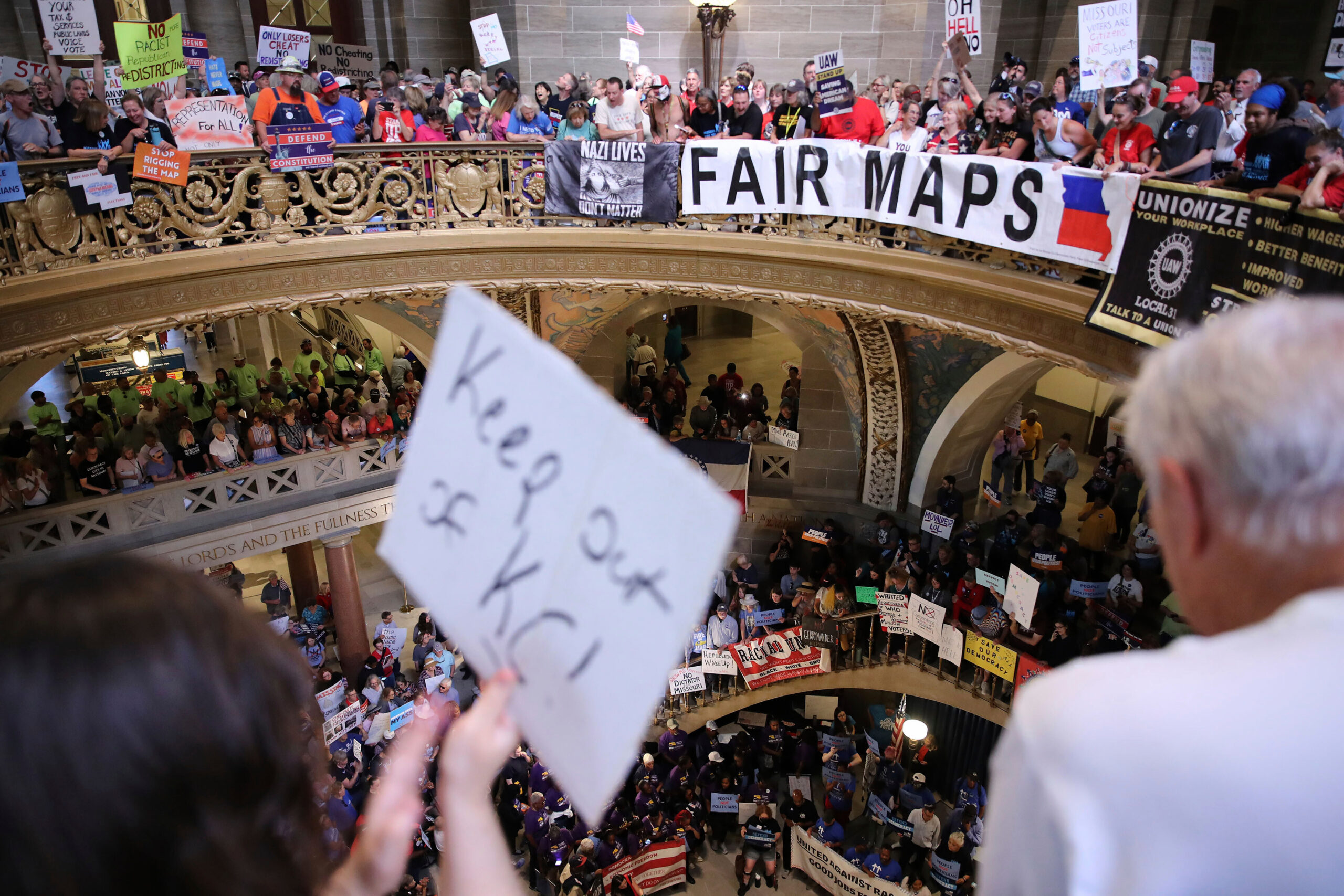
In a separate hearing set for Thursday, a state judge will consider whether Missouri officials must accept thousands of rejected signatures gathered as part of a citizen referendum effort to block the map. Organizers led by Richard von Glahn, executive director of People Not Politicians, must gather over 106,000 signatures by Dec. 11 to put the measure to voters.
The Missouri General Assembly passed the gerrymander Sept. 12 and sent it to Gov. Mike Kehoe (R), who signed it into law Sept. 28.
After the legislature approved the new map, opponents began collecting signatures in support of a referendum. But state officials claim the signatures are only valid if collected after the governor signed the bill into law.
“Depending on what the court could decide, it could affect as many as 100,000 signatures,” said Hatfield, who is also representing the plaintiffs in the signatures lawsuit.
Hatfield said the judge could rule by Dec. 11, but is not required to do so.
The Missouri Legislature and Secretary of State have filed a federal lawsuit challenging the referendum. A preliminary injunction hearing is set for Nov. 25.
That’s just one of several ways Missouri Republicans are hoping to stymie the measure. State officials have also tried to reject the petition for being filed too soon and introduced deceptive proposed ballot language that referendum organizers say will likely be challenged in court.