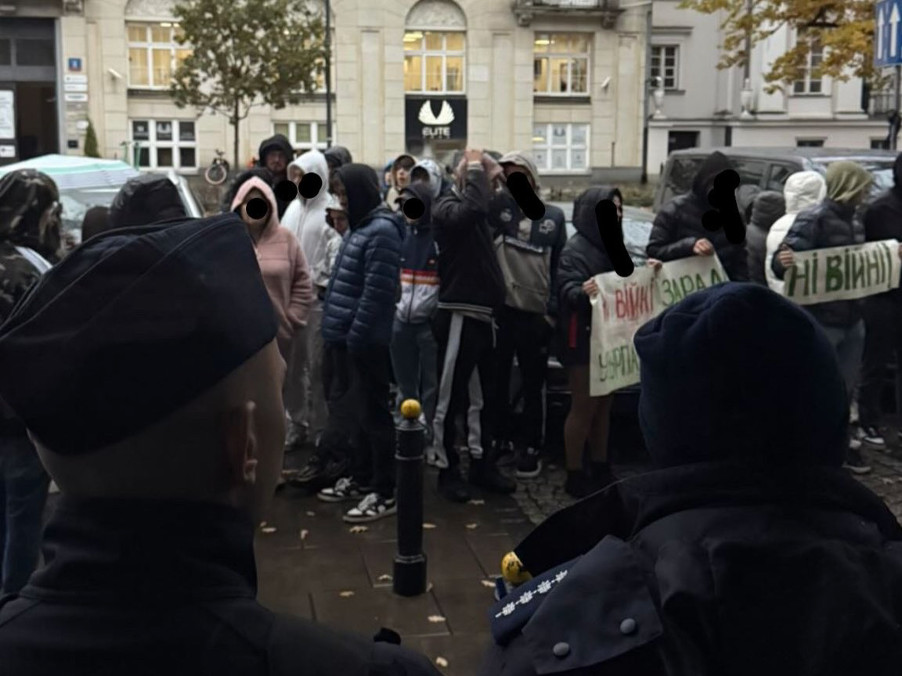
On Oct. 30, dozens of people gathered outside the Ukrainian Embassy in Warsaw to protest against… war. Why not in front of the Russian Embassy – the aggressor’s? And who actually organized this “peaceful” protest?
According to Kyiv Post sources, between 50 and 100 people took part in the demonstration, most of them very young. Some held signs reading “No to war” written in Ukrainian. On the surface, it looked like a peace protest. Yet the location – the embassy of the country under attack, not the aggressor – immediately raised red flags.
JOIN US ON TELEGRAM
Follow our coverage of the war on the @Kyivpost_official.
Embassy staff said they had not been informed about the event, which suggests the demonstration was not spontaneous. Instead, it appeared to be carefully planned – possibly as part of a disinformation effort.
150 zł ($40) for taking part in a protest – ads posted online
A day before the event, ads appeared on several Ukrainian- and Russian-language social media groups in Warsaw, inviting people to join a “peaceful protest.” Kyiv Post reviewed the posts. The alleged organizer, claiming to represent a non-existent foundation, promised participants 150 zł ($40) for attending. The ads used emojis in blue and yellow – the colors of Ukraine’s flag – and slogans like “Help draw attention of the media and politicians.”
The profile behind the recruitment posts turned out to be fake. It used a Polish name, had no other activity, and the profile picture was uploaded the day before. The Telegram contact listed in the ad was also fake – its handle referred to the Mexican drug lord El Chapo.
Other Topics of Interest
Russia Targets Ukrainian Snack Giant in Overnight Drone Strike
A Russian “Shahed” drone hit a Star Brands warehouse in Pavlohrad, destroying food supplies worth millions. It’s the second strike this year on one of Ukraine’s largest snack producers.
This kind of operation fits a familiar pattern of Russian disinformation. By using pro-Ukrainian language and symbolism, organizers sought to lower suspicion and make participants believe they were doing something meaningful – not taking part in a provocation.
Russian provocation or social experiment?
No journalists appeared at the protest, even though the ads had promised media coverage. That suggests the demonstration could have been a test – a rehearsal for a larger operation or a probe of public reaction.
It is also possible that footage from the event was recorded on mobile phones. Such material could later be used in propaganda: “Ukrainians protest against war outside their own embassy.”
No one has been caught red-handed, but the direction from which this operation may have originated seems obvious.
How Russian intelligence operates in Poland
This was not an isolated case. Russian and Belarusian intelligence services have been highly active in Poland, carrying out various destabilization and disinformation operations.
Polish authorities have repeatedly reported detaining individuals – including Ukrainians, Belarusians, and Poles – suspected of espionage, sabotage, or aiding Russian intelligence. Many are one-time agents recruited via Telegram, often unaware of who they are truly working for.
Ukrainians living in Poland are a particular target. Apart from the intelligence value, recruiting them also serves a cognitive purpose – to erode trust and fuel anti-Ukrainian sentiment in Polish society. In this way, Russia kills two birds with one stone: it advances its operational goals while sowing division and distrust.
Who gets recruited and why
Those drawn into such operations usually fall into a few groups:
- Young and naïve individuals who do not realize who is behind the offer
- People from criminal circles who think they’re participating in petty schemes, not espionage
- Individuals under financial pressure or blackmailed with compromising material
- And sometimes ideological pro-Russian sympathizers – the so-called “zhduns” – who genuinely support Moscow’s agenda
Financial desperation and lack of awareness are common denominators.
Disinformation and resilience
The protest outside the Ukrainian Embassy in Warsaw may seem minor, but it is significant. It shows how easily a fake protest can be organized in the heart of the Polish capital – and how little it costs to manipulate public perception.
It is a textbook example of Russian disinformation tactics: low-cost, high-impact operations aimed at undermining trust and spreading confusion.
Ultimately, the resilience of society – its ability to recognize manipulation and resist provocation – remain the strongest safeguard against such hybrid threats.
The views expressed are the author’s and not necessarily of Kyiv Post.