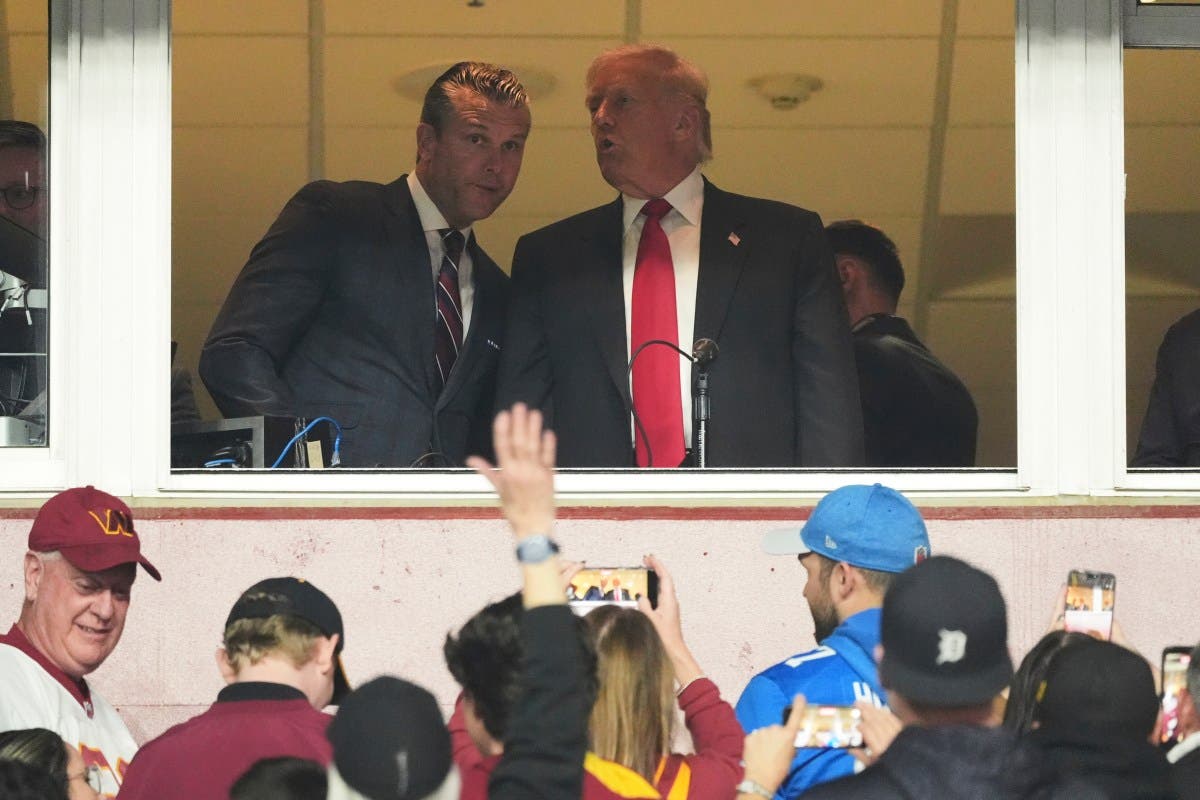
President Donald Trump on Wednesday received updated military options for potential operations in Venezuela, including possible land strikes, according to CBS News. Senior defense leaders, including Secretary of Defense Pete Hegseth and Joint Chiefs Chairman Dan Caine, briefed the president on scenarios for the coming days.
No final decision has been made, CBS News reported. When reached via email Thursday, the Pentagon referred Newsweek to the White House for comment. Newsweek has reached out to the White House via email.
Meanwhile, on Thursday, Hegseth announced Thursday that the U.S. military’s expanding anti-drug campaign in the Caribbean will now be known as “Operation Southern Spear.”
Why It Matters
The briefing came as the USS Gerald Ford carrier strike group entered the region and U.S. forces intensified recent strikes on vessels accused of drug smuggling.
At least 76 people have been killed in 20 U.S. military strikes in international waters since August, according to figures released by the Trump administration. The operations began in the southern Caribbean near Venezuela’s coast but have recently shifted to the eastern Pacific, where U.S. forces have targeted boats off Mexico.
The Trump administration, backed by Secretary Hegseth, has defended the strikes near Venezuela as part of a broader campaign against what it calls “narco-terrorists” and transnational criminal networks. Hegseth has argued that drug-trafficking vessels operating in the Caribbean and eastern Pacific pose a direct threat to U.S. national security and that the operations fall under the president’s war powers.
Is the US Going to War With Venezuela? What to Know
The U.S. intelligence community helped provide information for the potential operations, CBS News reported. Director of National Intelligence Tulsi Gabbard did not attend the White House discussions because she was returning from an overseas trip, while Secretary of State Marco Rubio was in Canada for a G7 meeting of foreign ministers.
The arrival of the USS Gerald R. Ford in Caribbean waters has started what one defense expert calls a strategic “shot clock,” forcing the Trump administration to decide whether to act militarily against Venezuela or retreat—each with profound geopolitical consequences.
The Ford strike group, including three guided-missile destroyers, entered the U.S. Southern Command area of responsibility on Tuesday, expanding the U.S. military footprint to roughly 15,000 troops across a dozen warships in the region. The deployment, officially part of a counter-narcotics campaign, comes amid intensifying speculation that the White House may consider direct strikes against Venezuelan targets.
The Ford’s presence, Mark Cancian, senior defense adviser at the Center for Strategic and International Studies, explained, presents a narrow window for action: a visible display of force that cannot linger without consequence. If used, it could signify the beginning of a broader campaign. If withdrawn, it could be seen as a strategic climbdown and a sign to Venezuelan President Nicolas Maduro that President Trump is bluffing.
The aircraft carrier group was ordered into the region on October 24 by Hegseth, who relocated it from the Mediterranean. According to the Pentagon, its mission is to “detect, monitor, and disrupt illicit actors” operating drug-trafficking routes that span from the Pacific to the Caribbean. But the scale of the deployment and its proximity to Venezuela have signaled a broader intent.
What People Are Saying
Cancian told Newsweek, “There’s no strategic rationale for sending the Ford to the region unless it’s intended for use against Venezuela. The shot clock is now running—this carrier can’t just sit idle. They’ll either need to act or redeploy it, and pulling back would amount to backing off.”
He continued, “The Ford is too powerful a capability to just sit in the Caribbean and do nothing,” Cancian said. “They’ll probably run some exercises, but it won’t be able to sit there week after week.”
In a message on X, Colombian President Gustavo Petro ordered his nation’s security forces to stop sharing intelligence with the United States, until the Trump administration stops its strikes on suspected drug traffickers in the Caribbean.
Petro wrote that Colombia’s military must immediately end “communications and other agreements with U.S. security agencies” until the U.S. ceases its attacks on speedboats suspected of carrying drugs, that critics have likened to extrajudicial executions. Petro wrote that “the fight against drugs must be subordinated to the human rights of the Caribbean people.”
Petro said during a summit between Latin American and European Union leaders hosted by Colombia on Sunday. “He may have been carrying fish, or he may have been carrying cocaine, but he had not been sentenced to death. There was no need to murder him.”
What Happens Next
Venezuelan Defense Minister Vladimir Padrino López said Tuesday that troops, civilian militia members, police officers and ruling party organizers will be mobilized for a training exercise to protect the country’s airspace. His announcement was broadcast on state television from a military base in Caracas, where he stood beside a surface-to-air missile system, though no training activity was visible elsewhere in the capital.
Updates: 11/13/25, 12:36 p.m. ET: This article was updated with new information and remarks.
Updates: 11/13/25, 3:03 p.m. ET: This article was updated with new information and remarks.