





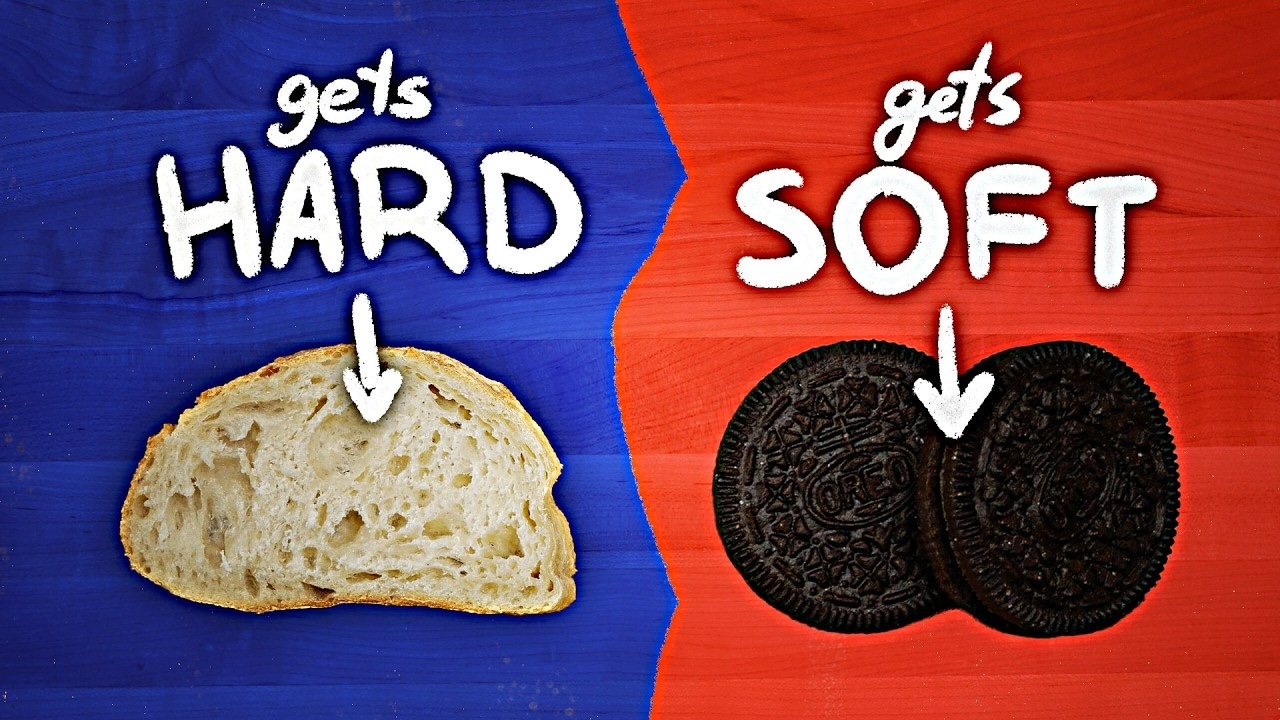
Kate Yoshida of MinuteFood explains why stale bread gets hard but stale cookies get softer. It all has to do with retrogradation during the bread-baking process, where starch molecules reorganize from crystallized to viscous and then back to crystallization when bread is cooled, squeezing out the water molecules and allowing the bread to go stale.
Flour – like all grain-based products – contains starch. And when you add water to starch and heat the whole thing up past a certain point, the starch granules start to absorb the water; the water sneaks into the nicely-organized starch molecules inside each granule and starts bonding with them, loosening up their structure. This process is a big part of what makes bread moist and tender. …Because starch molecules REALLY like order – energetically, they “want” to get back to a more organized structure. So as bread sits around, the starch molecules start reorganizing themselves back into crystals, squeezing out the water that was making them all loosey-goosey.
Cookies are baked differently, with far less water, so the starch never has a chance to reorder itself.
Like bread, cakes get harder as they age because of retrogradation. And while cookies, too, contain water and starch, cookie dough doesn’t usually contain enough water to interact with all the starch; plus, other ingredients in cookie dough compete for the little water that IS there. So very few of the starch molecules in a cookie get loosey-goosey in the first place – and as a result, they never retrograde; so a cookie’s staling is almost exclusively due to moisture migration.
Retrogradation also explains why food tastes better the next day.