



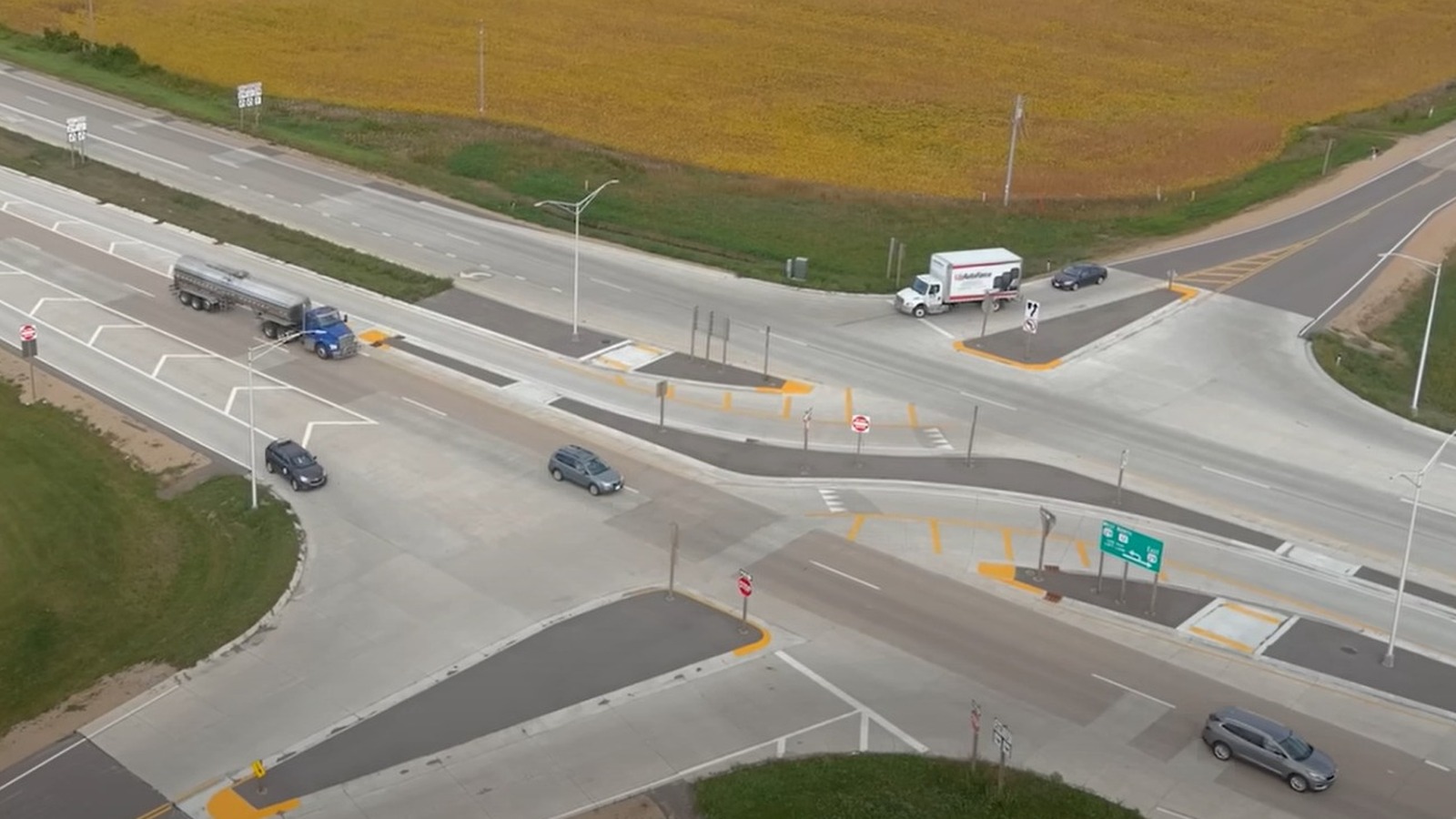
When you read the headline you probably thought we were going to talk about roundabouts, didn’t you? Roundabouts have been slowly finding their way into intersections across the U.S., much to the ire of many drivers. But roundabouts are old news. The new heat in the world of intersections and civil engineering is something called an RCUT, also known as a J-turn or superstreet.
RCUT stands for Restricted Crossing U-Turn. These intersections force drivers making left turns to make U-turns. That might seem counterintuitive when it comes to making roads safer — it sure did to us before we did the research. But RCUT intersections reduce what is known as “vehicle conflict points” — places in an intersection where cars can collide — by half.
How do they work? Mostly, they’re put where side roads meet busy roads. Drivers coming onto a major road from a side road must turn right to get on to that road. What if you need to go straight or turn left? Once you get on the main road, there’s a dedicated lane that leads to an opening for a U-turn down the road. After making the U-turn, you can make a right to continue traveling on the side road or keep going if you originally needed to turn left. This also reduces the number of traffic lights and the time drivers spend waiting for lights to change, thereby saving everyone time.
RCUT intersections are safer and save time
Still not convinced that RCUT intersections can reduce accidents? The statistics speak for themselves. The U.S. Department of Transportation studied the effects of installing RCUT intersections in five states. It found that overall crashes decreased by 15% and injury crashes by 22%.
In 2021, Faunsdale, Alabama installed an RCUT intersection at U.S. 80 and State Route 25. The results were dramatic. Crashes overall decreased by 75%, while severe accidents dropped by a whopping 99%. Perhaps the most significant result is that deadly crashes dropped to zero.
Other places have had similar results. Nebraska turned the intersection of U.S. 81 and Nebraska 91 into an RCUT in 2021, and saw a 54% drop in crashes and 96% drop in injuries and deaths by 2023. North Carolina reports that the number of crashes dropped between 27% and 74% at 13 rural intersections converted into RCUTs. Maryland saw a 44% drop in crashes at RCUT intersections, while Missouri had a 54% drop in crashes that resulted in injuries and 35% decrease in overall accidents. (Of course, a great way to avoid traffic deaths is to change our behavior, but nobody wants to.)
What about time saved for commuters? The Federal Highway Administration says converting conventional intersections to RCUTs can increase traffic flow by 30% and decrease intersection travel time by 40%. For example, San Antonio, Texas found that implementing RCUTs along U.S. 281 decreased northbound travel time in one section from 19.2 to 12.7 minutes during evening rush hour while increasing average speeds from 19 to 29 mph.
Why do these intersections deliver these results? Fewer traffic lights. The lights for the major roads stay green longer. And since travelers from the side roads are only turning right, they sometimes get to go on red.
RCUTs versus roundabouts
Here’s a hot take — hot, at least, for our fellow Americans. We like roundabouts. There, we said it, and we don’t care who knows it. That’s not exactly a popular viewpoint in the USA, though opinions in a community tend to become more favorable after a roundabout is installed. Roundabouts are so easy, in our opinion (even if Waymo Robotaxis are sometimes confused by them). There’s no waiting in a long line of cars for a light to turn green, hoping you get to the intersection before it turns back to red. There’s no navigating four-way stops, trying to remember from driver’s ed who has the right of way. You don’t even have to stop if no one is coming.
So why would a city, county, or state install an RCUT instead? These intersections are actually made for two different types of intersections. Roundabouts are best suited for intersections where two or more similar streets meet. In other words, they’re great for intersections of two busy roads or two side streets, and not so great where a minor back street meets a major thoroughfare.
RCUTS, on the other hand, are for intersections where minor side streets with little traffic meet major roads with a lot of traffic. They’re designed to reduce the time drivers spend at traffic lights by forcing drivers from side streets to enter major roads via right-hand turns. They don’t work so well at intersections with a lot of left-turn traffic from the side road.
There’s no one-size-fits-all solution for every intersection. But whether it’s RCUTs or roundabouts, saving lives and making our commutes shorter are good things.