







There is a truck for almost every buyer today, but one niche that is missing is the old coupé utility. In decades past, little trucks like the Ford Ranchero and Chevy El Camino provided a sort of best of both worlds. They were cars and trucks at the same time! These pickups are gone now, but they didn’t go without a fight. For a couple of decades, GM tried to expand the appeal of the car-truck mashup concept by offering luxury utes. This is the Coupe De Ville Caribou, a glorious attempt to combine the best features of luxurious cars and practical pickup trucks into one machine, ready for you to take home from your local Cadillac dealer.
America fell fully in love with the coupé utility in the 1950s. The utes of the era were far from the first, as there had been cars with beds and trays on them since the dawn of motoring. In the early decades of the car industry, you could get the Ford Model T with a bed, and there was such a thing as the roadster utility, a sporty car with a utility bed. The concept of the coupé utility as we know it today first appeared the 1930s in America and Australia, where buyers could hook themselves up with utes like the Chevrolet Coupe Delivery and the Studebaker Coupe Express.

Yet, utes would remain closer to niche products until December 1956, when Ford launched the Ranchero. What made the Ranchero a big deal was that it was a stylish and dignified car, but it also had a bed that carried 50 pounds more than some F-Series models of the era. The Ranchero was marketed as the best of both worlds, a truck that wasn’t afraid to get dirty on the farm during the week that could take you to dinner with polite company on the weekend.

In 1959, General Motors came out swinging with the Chevy El Camino. The General was late to the party, but the El Camino was executed well enough that it outsold the Ranchero throughout its run, and then continued to sell for years after Ford threw in the towel on an idea it helped popularize.
Weirdly, Chrysler didn’t hop into the market until 1982 with the Dodge Rampage, which came three years after Ford canned the Ranchero. Other brands also joined in, with Volkswagen selling the Rabbit pickup and Subaru bringing over its famed BRAT.
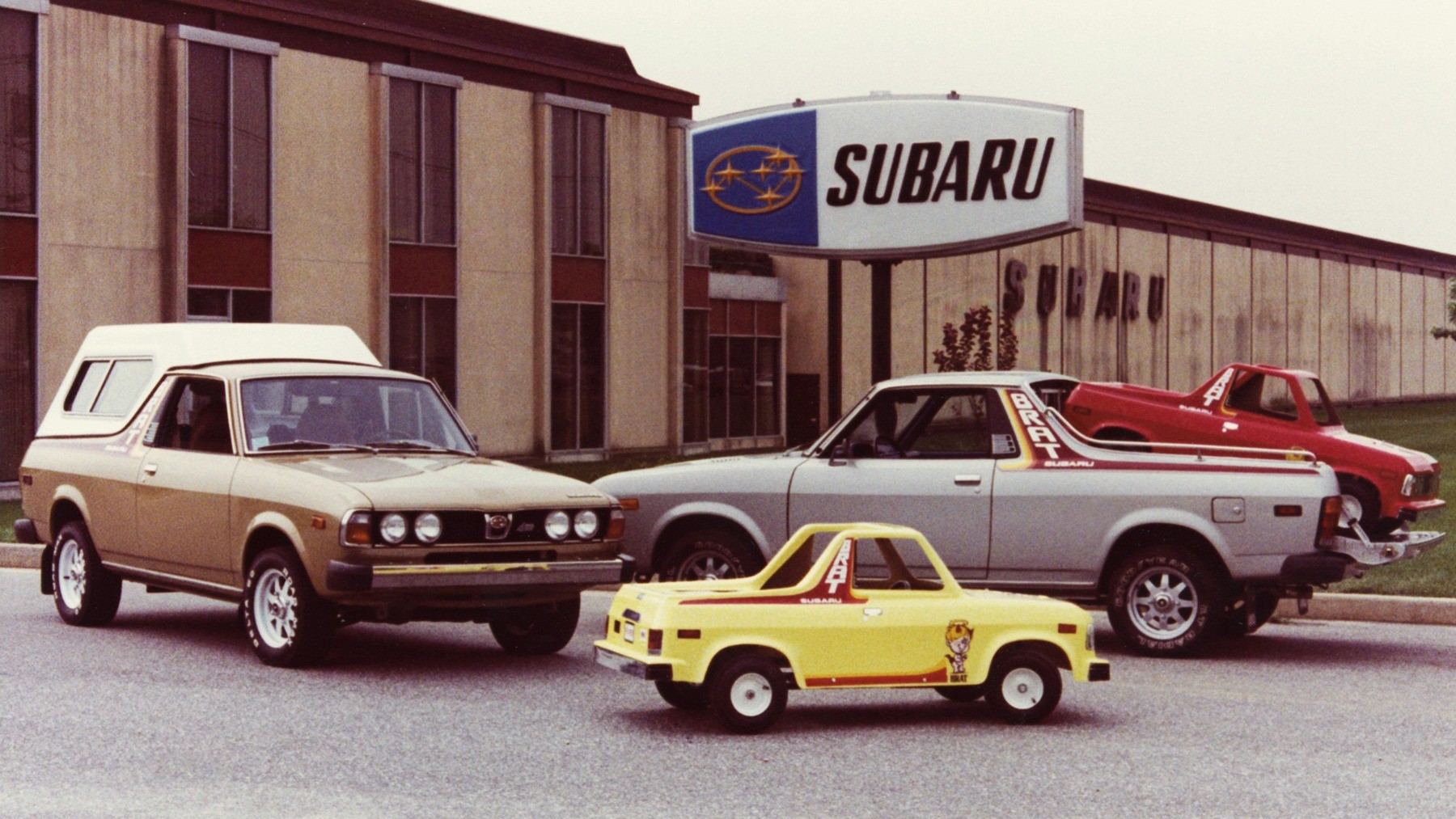
Something a bit fascinating about America’s coupé utilities is that, while they combined the comforts of cars with the working traits of trucks, they largely stayed away from fully diving into the luxury market. Chevrolet and GMC had utes, as did Plymouth and Dodge, but you didn’t see a ute from Lincoln or Cadillac, at least not officially. Instead, if you bought a car-like pickup truck from a Cadillac dealer from the 1950s to the 1980s, it was a car that had been converted into a truck.
Not A Mirage

If my story sounds familiar, it might be because you read the piece I wrote in January about the Cadillac Mirage, below. But there was another company in America that had the same idea to make super luxurious car-based pickups out of Cadillacs, and that company is the one we’re looking at today.
When I wrote that story, I could not find a single converted Caddy truck that was currently for sale. I am so stoked to tell you that I’ve finally found one, a model made by the lesser-known Caribou Motor Corporation. And it’s just as cool as the Mirage.

Outfits like the Caribou Motor Corporation, the Traditional Coach Works, and Florida Motor Coach served a niche within a niche. They built trucks and station wagons for people who thought that existing pickup trucks and wagons were not elegant enough. Extreme luxury trucks are all over America today, but that wasn’t really the case in the mid-20th century. If you wanted a truck with the luxury of a Cadillac or Lincoln, you had to make one, so these companies did just that.
There is shockingly little information about the Caribou Motor Corporation out there. One Cadillac historical resource claims the company built Cadillac trucks from 1954 into the 1980s, while Hemmings reports that Caribou was first called the Formal Coach Corporation before its name change.

That explanation is plausible. The Formal Coach Corporation built the Cadillac Eldorado Comstock Pickup as well as a Cadillac shooting brake. Caribou built the same sort of weird utilitarian Cadillacs. For some bizarre reason, Caribou also got into the business of doing facelifts. One kit converted the round headlights of early 1970s Cadillacs to rectangular headlights.
What I have been able to confirm about Caribou’s origins is that engineer Louis Schorsch was the President and designer at the company. Louis is the only name I have found associated with this company, which was located in Grover City, California.

It’s not clear why Louis got into building Cadillac and Lincoln trucks, or what he did before this. However, the result was largely the same as the other efforts. His conversions turned luxury Cadillacs into pickup trucks.
Coupe De Ville Trucks
The most common examples of Caribou’s builds – which isn’t saying much because they’re all rare – come from the 1970s. According to brochures that I could find during that era, Caribou concerned itself with turning Cadillac Coupe De Villes into pickup trucks and wagons, as well as converting Continental Mark Vs into pickup trucks. As I mentioned earlier, Caribou was also messing around with converting the faces of Cadillacs, too.
The Caribou brochures that I was able to find do not describe how these vehicles are built. Instead, they just say that the truck body is built out of a seamless one-piece construction. To give you an example of how other car trucks were built, Gene Winfield of the Traditional Coach Works would cut a Cadillac out from behind the rear seats, and then add in his own custom metalwork. His Caddy trucks were actually longer and wider than their donor cars were, and he used a planishing hammer to achieve factory-like smooth compound curves. In other words, the Caddy trucks weren’t just hacked apart and a bed dropped in where the rear end used to be.

Anyway, Caribou’s pickups were sold in two ways: you could buy the kit version and go DIY or have a shop assemble it for you; or you could buy a completed Caribou from a Cadillac dealer. These builds didn’t seem to get a blessing from Cadillac, so the Cadillac Caribous weren’t “official.” Caribou said that whoever was tasked with building your car would take around 50 hours to complete the conversion. Advertisements said that the way it worked was that you bought the car first, and then offered it up to be converted. Caribou recommended that the donor vehicle be in the best condition that it could be in, and that it was not wrecked. The company also claimed that your truck would be built to Cadillac standards.
Annoyingly, while multiple companies went through the work to turn Cadillacs and Lincolns into pickups, I have not seen any advertised figures for payload or towing. That said, Caribou says that developing the truck kit took two years. In the 1980s, you could also get these with an electrically folding tailgate.
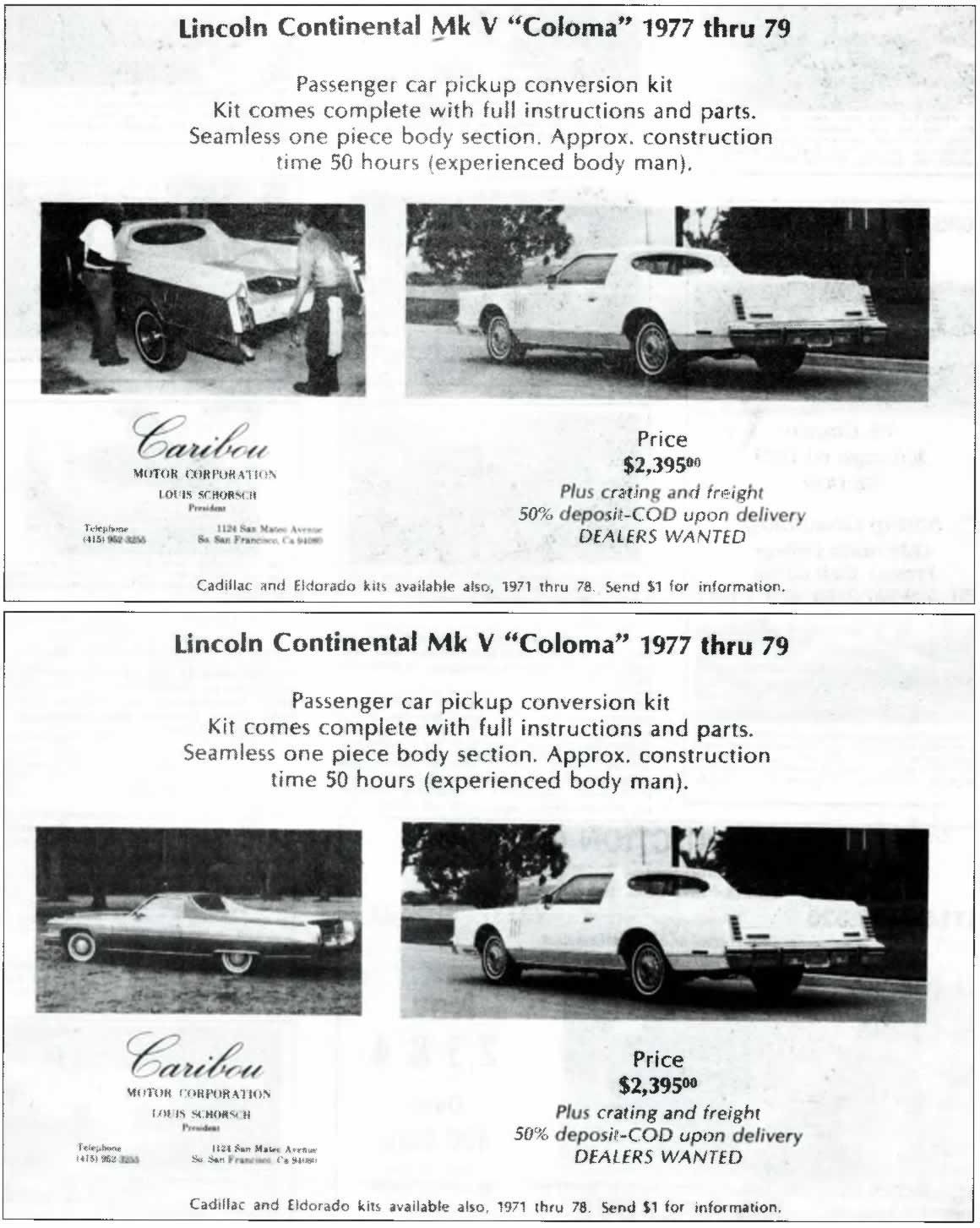
In 1979, Caribou sold its ute kits for $2,395 ($11,389 in 2025). I could not find the price of completed cars from the same year, but one advertisement from 1986 says that converting a 1974 to 1976 Coupe De Ville would cost you $10,500 ($31,116 in 2025), a 1977 to 1979 Coupe De Ville conversion would cost you $12,500 ($37,043 in 2025), and any Coupe De Ville conversion up to 1986 would run you $14,500 ($42,970 in 2025).
Keep in mind that in 1986, a brand-new Coupe De Ville would have set you back $20,754 , so this conversion cost as much as most of another Coupe De Ville. If you were bold enough to do this, you had to pay half down up front. What you got out of the other end was awesome.
This Caribou Cadillac

This brings us to the 1973 Coupe De Ville Caribou that’s for sale on Facebook today. These things are so rare that I did a double take when I saw this one. Seriously, I was actually drooling over a camper when I saw this ride.
The De Ville series entered its fourth generation in 1971 with a completely new design alongside the rest of the Cadillac lineup. From GM:
Cadillac introduced a new look of luxury leadership when it unveiled the completely restyled 1971 model year lineup. These breath-taking designs were sure to continue the position of Cadillac being America’s favorite luxury car. Among them was the Coupe DeVille, a perennial favorite among fine car owners – and those who wished they owned one! Beneath the sculptured beauty of the exciting Coupe DeVille were new conveniences, new luxuries and new engineering innovations, all redesigned to provide smooth, quiet and confident operation. With its world-class comfort and convenience features, combined with outstanding quality, this car reaffirmed the tradition of leadership that long made Cadillac the “Standard of the World” in distinctive motorcars. But, what about the car’s traditional segment-leading performance for 1971?

History records 1971 as ushering-in the era of smog-controlled engines for all cars sold in the United States. This seriously impacted horsepower and torque for many manufactures. Nonetheless, the 1971 Cadillac lineup still delivered pleasing performance. To enable the use of low-lead or no-lead gasoline, the car’s massive 472 CID engine’s compression was lowered nearly 2 points (to 8.8:1). Still, even with 472’s horsepower rating being reduce by 8% (30hp less), the torque was only down 5%, so it still produced a tremendous 500 ft. lbs. at 2800 rpm. Consequently, because of such impressive mechanical design efficiencies honed over the previous 4 years, this engine’s output remained strong and continued to be an awesome power-plant. Ultimately, the car continued to seamlessly deliver the level of performance to which Cadillac owners were accustomed.
In 1973, the De Ville got giant, energy-absorbing bumpers. Power came from a 472 cubic inch (7.7-liter) V8 good for 220 HP. Remember, this was right during the emissions era, so you got massive engines that made lower power by today’s standards. Anyway, those ponies reached the rear wheels through a three-speed automatic.

The seller of this Cadillac Caribou says that it was given a frame-on restoration 10 years ago. It looks like that restoration has held up well. The leather bench seat looks to be in good shape, as does the dashboard. The seller claims that the car runs and drives perfectly, but the air-conditioner doesn’t work. Advertised features in 1973 included “soft pillow” door panels, power brakes, variable ratio power steering, power mirrors, power windows, power seats, automatic headlights, eight different radio choices, an outside thermometer, automatic climate control, and more. The Cadillacs of this year even had a computerized rear wheel skid control system.
The truck part of this equation looks pretty good. The bed appears to be clean, suggesting that this hasn’t been used as a truck in at least 10 years. What’s pretty neat is that the bed has a hatch that reveals a space for more cargo or for a spare tire. This well appears to be in good shape, too!


The only real blemish shown in the admittedly low-resolution photos is a crack in the paint or bodywork, but the image is so zoomed in that you can’t tell where the crack is.
One weird feature this example has is a device that repeatedly flashes the headlights. It also has a siren and a public address system. The seller says these are there for parades.
Ridiculous, In A Good Way

This big boat has 68,000 miles on its odometer, and you can get it from the seller in Lena, Illinois, for $30,000. Normally, I’d say that the air-conditioner problem and the crack might be dealbreakers. Is the crack there because of Bondo? However, these cars are so rare that it might be worth buying and performing what few repairs they need.
It’s hard to ascertain just how rare these cars are. I’ve seen random listings claim that there were fewer than 100 examples made each year, but there’s no proof of this, so who knows. One thing is for sure, and it’s that you don’t see one of these every day.

This Caddy truck came from a strange time when luxury trucks were a niche, and more than one company thought there would be enough people lining up to have a ute with a Cadillac badge. As silly as it must have seemed back then, these builders were largely correct, only several decades too early, and with the wrong brands.
Thankfully, this car-to-truck conversion spirit never died, and you can still buy kits to convert all sorts of cars today. Maybe, one day, someone might be crazy enough to give the world a Blackwing coupé utility.
Top graphic image: Facebook listing