






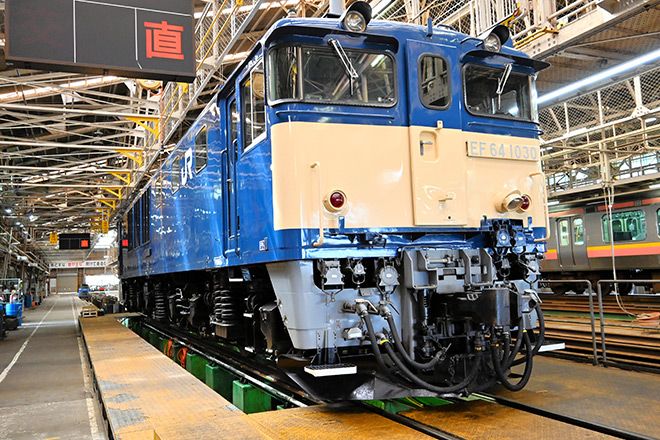
The day three “grim reapers” of the train world will join their brethren in the scrapyard is fast approaching after decades of ferrying countless trains there.
JR East, or East Japan Railway Co.’s decision to retire its EF64 models from commercial service of pulling passenger cars by Nov. 24 is part of a move to streamline its car maintenance process.
Rail workers have reacted with gratitude to the three locomotives for their role in helping give old trains a new life in addition to their “shinigami” (death god or grim reaper) moniker.
BUILT FOR MOUNTAIN ROUTES
Situated south of Nagaoka Station in Nagaoka, Niigata Prefecture, the former site of the sprawling rolling stock depot once accommodated a myriad of locomotives and trains for the regional Joetsu Line.
The three reapers continue to call it home even after its Niigata city counterpart, more than 60 kilometers away by rail, took over operations in 2023.
This was due to the well-equipped maintenance facilities for the EF64 in Nagaoka and dedicated maintenance personnel commuting from Niigata city.
The standard EF64 model was developed in 1964 during the era of JR’s predecessor, Japanese National Railways (JNR), in a quest to figure out how to effectively traverse the steeply sloping sections along the Joetsu Line and other areas.
Ultimately, a total of 132 units were released under the umbrella model at the time, and the EF64 was commonly referred to as the “mountain man” for its exceptional ability to barrel up hillier routes.
Of these units, the No. 1030, No. 1031 and No. 1032 locomotives for Nagaoka were later introduced in the early 1980s. The trio’s bodies were significantly modified from the basic EF64 model and included winter-ready enhancements to withstand service in areas with heavy snowfall.
The three EF64 in Nagaoka were initially known for pulling what was affectionately dubbed the Blue Train during the popular sleeper express’ heyday. The locomotives were not only linked to this Hokuriku train bound for Kanazawa but also the Akebono to Aomori.
All three are also outfitted with a dual coupling system that enables them to haul electric trains as well as nonpowered passenger carriages and freight cars.
This feature was instrumental in their “transformation” into death gods since locomotives are typically equipped with a coupler that is only compatible with passenger and freight cars.
Missions regularly involved bringing decommissioned rolling stock primarily in greater Tokyo to a scrap site in Nagano Prefecture, and they were most recently tasked with bringing historical trains in for demolition.
The Odoriko express’ retired 185 series was the first to go in June and was followed in September by the elegant overnight rapid train Cassiopeia.
Seeing the three EF64s towing them away heralded a flood of social media comments describing the locomotives as shinigami, along with others simply mourning the discontinuation of the high-profile trains.
NOT GONE, BUT REINCARNATED
Koji Nakano, 53, and Takumi Yanagida, 48, have a different take on the death gods. Employed at the Niigata rolling stock depot, both have done maintenance on EF64s for upward of 10 years and instead emphasized the model’s positive impact on Japanese trains.
“I want people to understand that the trio have similarly been playing the role of the ‘stork,’ a complete opposite of the grim reaper’s role,” said Yanagida, referring to the locomotives delivering new cars from the train factory in Niigata city to a range of destination throughout Japan.
Nakano agreed, saying that these so-called harbingers of death have been simultaneously responsible for giving scrapped machines a new life.
“Parts from dismantled rail carriages are recycled into raw materials for new trains. It can be said instead, then, that the three locomotives have been committed to supporting this fort of reincarnation since they have diligently sent trains to the scrapping facility daily,” Nakano said.
More than 40 years after their release, the No. 1030, No. 1031 and No. 1032 units are now the last operational EF64 models across the country’s six JR entities.
According to Nakano and Yanagida’s accounts, maintenance workers still diagnose malfunctions manually based on crew reports; this is at odds with the latest trains that have a self-diagnostics mechanism designed to immediately detect faulty components.
JR East is in the process of replacing this type of locomotive with the new E493-series commercial electric train.
This series debuted in 2021 and combines acceleration and braking into one handle. Operation and maintenance are the same as regular electric trains, supporting JR East’s efforts to improve rail service efficiency.
With its announcement that the final three EF64 will finish commercial operations of hauling passenger cars by November’s end comes another death knell. JR East expects that the trio will stop pulling out-of-service trains by spring, bringing their journeys to a close.