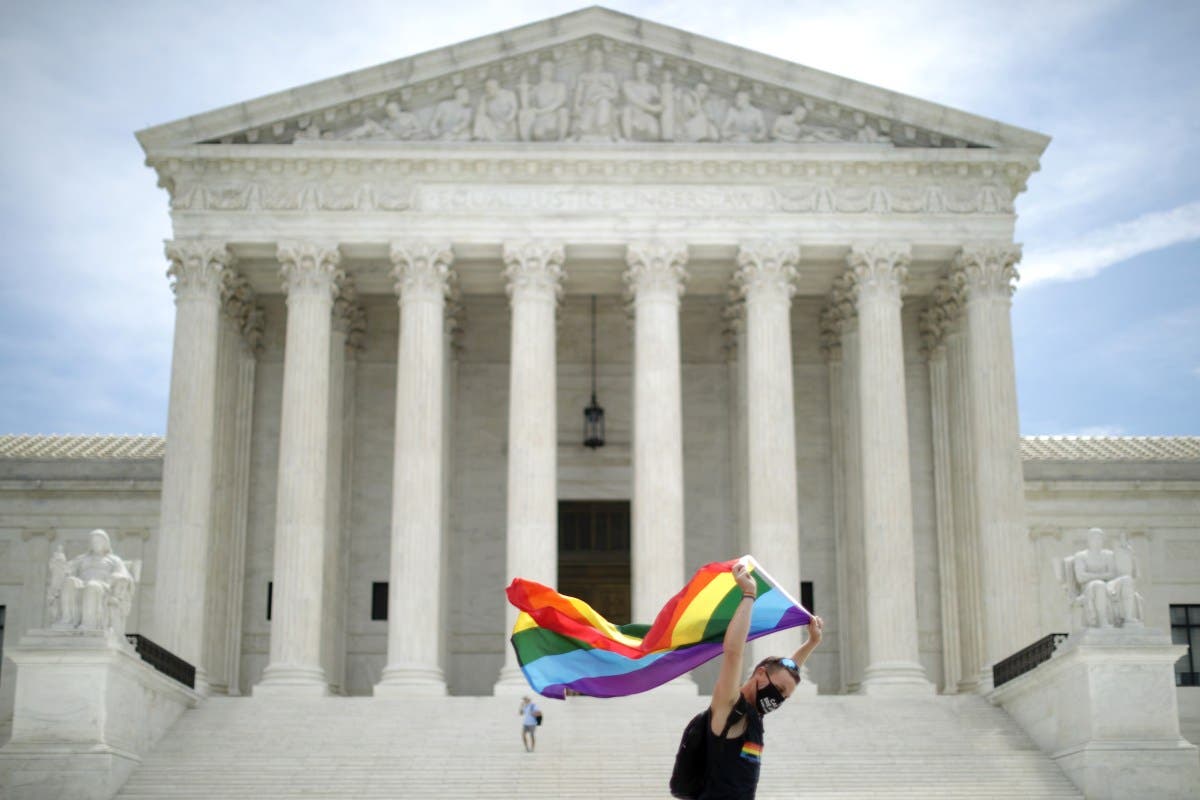
Jim Obergefell, the lead plaintiff in the landmark 2015 Supreme Court ruling that guaranteed nationwide same-sex marriage rights, is “worried” and warns that the precedent his case established is now facing a “scary path.”
The Supreme Court has scheduled a private conference for Friday to decide whether to hear a challenge brought by former Kentucky county clerk Kim Davis, which urges the Supreme Court to overturn Obergefell v. Hodges. Matthew Staver, attorney for Davis, told Newsweek last month that Obergefell “has no basis in the Constitution,” saying the decade-old decision “could be overruled without affecting any other cases.”
Although many legal analyst believe same-sex marriage rights are unlikely to be overturned, even by the conservative leaning Supreme Court, Obergefell told Newsweek in a Wednesday interview that he remains concerned. He pointed to the justices 2022 decision to overturn Roe v. Wade, which had guaranteed abortion access across the country for nearly 50 years.
“This court, to me, is far from normal, and that’s what concerns me. We now have a Supreme Court that has shown it is willing to turn its back on precedent, which had always been a bedrock principle for the Supreme Court,” he said.
Why It Matters
The deliberation over whether to revisit the Supreme Court’s Obergefell decision comes as conservative legal advocates, some Republican lawmakers and advocacy groups have renewed efforts to limit or roll back federal protections for same-sex marriage. With six Republican-appointed justices to just three appointed by Democrats on the nation’s top court, critics of the conservative majority fear the justices’ willingness to overturn precedent—particularly after Roe was reversed a little more than three years ago.
If the Supreme Court chooses to hear Davis’ case and ultimately overturns Obergefell, the question of marriage equality could return to the states, likely ending nationwide uniformity and impacting hundreds of thousands of couples. However, many legal analysts believe the justices will not overturn the precedent, and some additional legal protections for same-sex married couples were passed into federal law in 2022.
What to Know About Kim Davis Case
Davis became a national figure after she denied licenses to same-sex couples following the Obergefell ruling, over her religious objections. In September of that year, a judge held her in contempt, and she spent six days in jail. In Davis’ petition filed to the Supreme Court, her attorney raised religious objections to same-sex marriage. The Supreme Court confirmed in October that the justices would consider the case on November 7.
“Obergefell was ‘egregiously wrong,’ ‘deeply damaging,’ ‘far outside the bound of any reasonable interpretation of the various constitutional provisions to which it vaguely pointed,’ and set out ‘on a collision course with the Constitution from the day it was decided,'” Staver wrote.
The filing said that if the court overturns Obergefell, marriage rights would be returned to the states, but that any same-sex couples who were married since the ruling would be grandfathered.
Davis’ arguments have already been rejected by lower courts. A 6th District Court of Appeals panel earlier this year dismissed her First Amendment argument because she is being “held liable for state action,” rather than her individual actions.
“Although Davis’s assertions are novel, they fail under basic constitutional principles. Under § 1983, Davis is being held liable for state action, which the First Amendment does not protect—so the Free Exercise Clause cannot shield her from liability,” that ruling reads.
The Supreme Court also previously denied an appeal filed by Davis in 2020. Davis’ new appeal contends she should not be personally liable and has called on the Supreme Court to overrule Obergefell, charging that the decision lacks constitutional basis and has harmed religious liberty.
Some legal analysts believe the Supreme Court may agree to take the case, but ultimately could decide more narrowly that individuals should be granted religious exemptions from issuing marriage licenses to same-sex couples. Notably, this would align with a Texas Supreme Court decision from late last month, which granted judges in the state exemptions from performing same-sex marriages based on “sincerely held religious beliefs.”
“Even if the Court were to grant review, it may decide the case on narrow legal grounds and allow for religious accommodations for government officials like Davis instead of invalidating same sex marriage entirely,” former federal prosecutor Neama Rahmani previously told Newsweek.
Marilyn Chinitz, partner in the Matrimonial & Family Law Group at Blank Rome, shared a similar view with Newsweek, saying, “If the Supreme Court takes this case, it will not be to overturn Obergefell, but it could be reviewed in a narrow way, determining whether a state official can claim a religious exemption from performing official duties. It is unlikely that the Supreme Court will use this case to overturn the landmark case.”
What Obergefell Would Ask Kim Davis
Obergefell told Newsweek that even a more narrow ruling granting religious exemptions would open “Pandora’s box.”
“I just don’t see how our country, the country that we were promised and that we’ve been working towards, nder this Constitution could survive if every person has the right to say, ‘Well, my religious beliefs are more important. So what you’re asking for, even though it’s the law, you don’t get it,” he said.
The civil rights activist pointed out that Davis has been divorced several times, noting that this is counter to some Americans’ religious beliefs as well.
“I would like to say to Kim Davis, you’ve been divorced three times. When you went before a judge for your divorce hearings, how would have you felt had that judge said, ‘Well, sorry, Kim. My religious faith is such that divorce is wrong and that women cannot divorce their husbands. So your petition for divorce is denied,’ How would that feel?” Obergefell asked.
Conservative Supreme Court Justice’s Views on Obergefell
Conservative Justice Clarence Thomas, joined by Justice Samuel Alito, signaled interest in reexamining past precedents like Obergefell in a concurrence with the Supreme Court’s 2022 ruling overturning Roe. However, more recently Justice Amy Coney Barrett and Alito have commented publicly on the issue of same-sex marriage.
In October, Alito reiterated past criticism of Obergefell, in which he dissented. However, he also clarified: “In commenting on Obergefell, I am not suggesting that the decision in that case should be overruled.”
Barrett, appointed to the court in 2020 by President Donald Trump, told The New York Times‘ Ross Douthat last month that same-sex marriage has “very concrete reliance interest.” She defined reliance interest as “things that would be upset or undone if a decision is undone.”
In Barrett’s new book, Listening to the Law: Reflections on the Court and Constitution, which was released in September, she wrote that “rights to marry” are “fundamental.”
But Obergefell, like many other who are concerned about the Supreme Court’s conservative majority, takes little comfort in their words.
“I refer everyone back to Roe v. Wade. Why should we trust anything that comes out of these justices’ mouths?” he asked. “Because I’ve seen that they are willing to overturn a right that people relied on for almost 50 years in our nation. They’re willing to overturn that, even though they either said or intimated that it was settled law. So I don’t find much comfort in that, to be honest.”
2022 Respect for Marriage Act
After Roe was overturned, there was significant concern from many that same-sex marriage could also be next. In response, Congress passed the bipartisan Respect for Marriage Act later that year, which shored up protections for same-sex marriage.
While Supreme Court could still overturn Obergefell, and conservative states could then outlaw issuing same-sex marriage licenses, the bipartisan legislation requires states to recognize all marriages performed in other domestic or foreign jurisdictions. In the House, 39 Republicans voted “Yea,” as did 12 GOP senators—meaning a significant majority of the GOP lawmakers voted against the bill in both chambers.
What Polls Show About Americans’ Views of Same-Sex Marriage
Despite recent conservative backlash, support for same-sex marriage remains strong nationally—Gallup polling found 68 percent of Americans supported same-sex marriage as of May. However, Gallup’s polling also shows declining support among Republicans.
In 2015, the pollster showed that just 37 percent of Republicans thought same-sex marriages should be valid. The figure rose to a record high of 55 percent in 2022 and 2023. It has since dropped to 41 percent as of the spring—a double-digit decline.
What People Are Saying
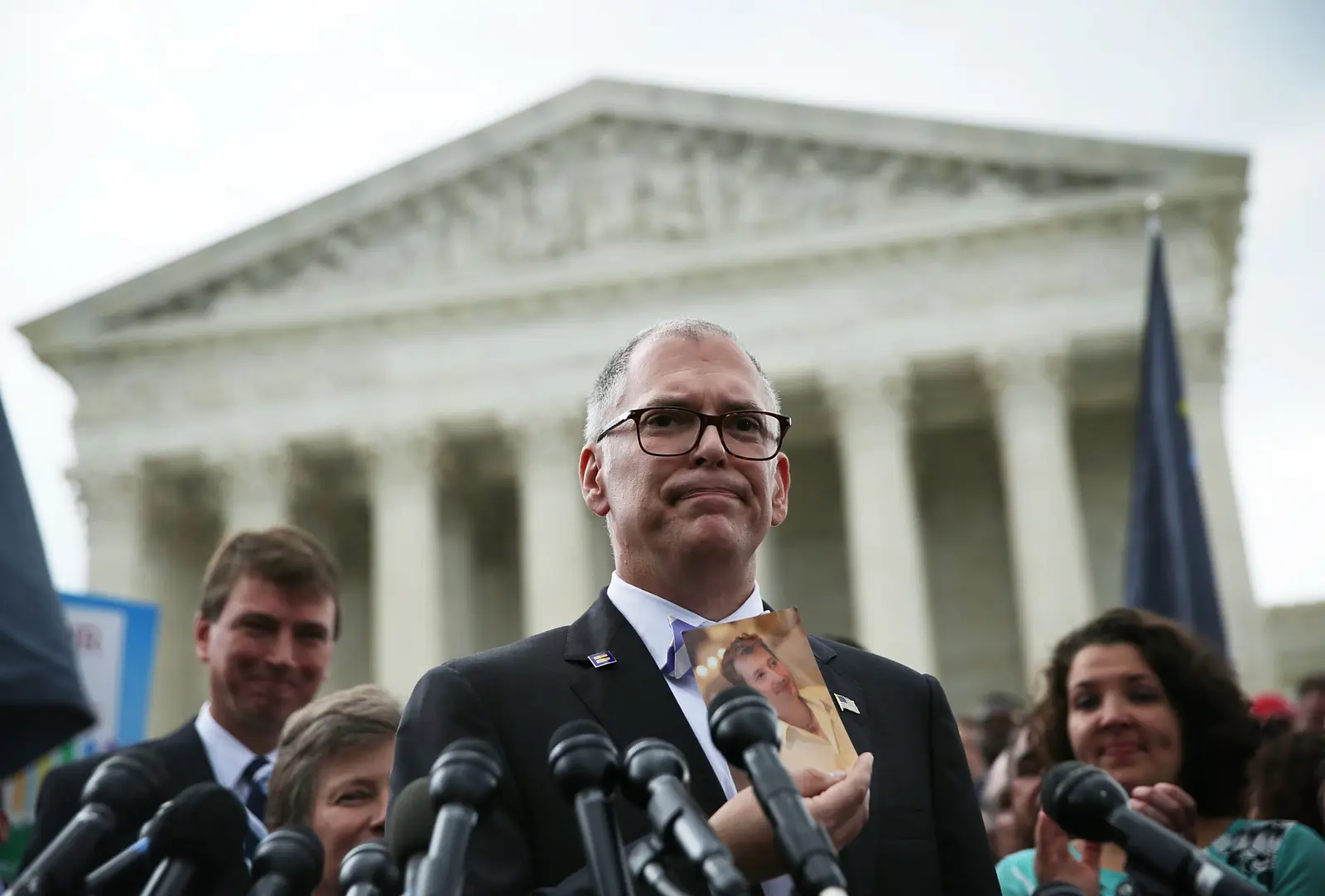
Jim Obergefell to Newsweek: “There’s the joy I feel because, I mean, several hundred thousand queer couples have gotten married, families have formed, and queer kids have grown up knowing that marriage is a possibility for them in the future. So on one hand, I just feel nothing but joy because I know the difference it has made. I know that it’s made this country a better place. But then that’s balanced by my fear for the right to marry. Given everything that’s happening in our nation.”
Matthew Staver, attorney for Kim Davis, told Newsweek in October: “Obergefell has no basis in the Constitution, and It’s not even rooted in substantive due process. It’s on an island by itself. I believe therefore Obergefell could clearly be overruled without affecting any other cases. And I think that’s the big difference here between the Obergefell and even the Roe v. Wade, the decision that was overruled in Dobbs, It’s on an island of its own creation.”
Former Secretary of State Hillary Clinton in an August interview on the Raging Moderates podcast: “The Supreme Court will hear a case about gay marriage; my prediction is they will do to gay marriage what they did to abortion — they will send it back to the states. Anybody in a committed relationship out there in the LGBTQ community, you ought to consider getting married because I don’t think they’ll undo existing marriages, but I fear they will undo the national right.”
Daniel Innis, chair of LGBTQ+ group Log Cabin Republicans, previously told Newsweek: “Most Americans… support our right to marry in our community. The big thing was, ‘Oh, it’s going to destroy traditional marriage.’ Really? You guys have pretty well done that on your own with a 50 percent divorce rate. So you didn’t need anything from us. Look, if anything, I think it’s brought us to a place where we’re more accepted in our communities, because now folks who maybe aren’t a part of our community are seeing that we have the same love and commitment for one another as they do for their spouses.”
Marilyn Chinitz, partner in the Matrimonial & Family Law Group at Blank Rome, told Newsweek: “Of course, Davis is free to hold her beliefs and no one is stopping her from doing so, but does she have a right as a government employee to deny others their constitutional rights while performing her public duties? The answer is no. The case really tests how far religious liberty extends for government employees. The Justices may view this case as a chance to clarify how government employees can be accommodated without violating other rights, but these public officials, as an extension of the government, have no right whatsoever to selectively perform their duties.”
What Happens Next
The Supreme Court is expected to announce soon after its Friday conference whether it will grant certiorari in Davis’ case. If the court accepts the case, oral arguments could be scheduled for the spring, with a possible decision by June. Should the court deny review, the lower court rulings against Davis, and in favor of the marriage-equality plaintiffs, will stand.
Update, 11/6/25 at 11:30 a.m.: Additional information was added.