



Sign up for the Slatest to get the most insightful analysis, criticism, and advice out there, delivered to your inbox daily.
Back in the summer of 2020, during the first year of COVID lockdowns, two first-party PlayStation games were released back-to-back, just a month apart: Ghost of Tsushima and The Last of Us: Part 2. Upon release, Ghost of Tsushima was pretty beloved by a specific right-wing culture-war gamer crowd, who placed it on a pedestal specifically as a way to directly attack The Last of Us: Part 2.
While The Last of Us: Part 2 is far from perfect (for example, Neil Druckmann, the game’s creator and co-director, took inspiration from the Israel-Palestine conflict that was criticized for both-sidesism), but the game’s sin on release for many on the political right was that it took a series whose lead was previously a man and continued its story with one lead who was a lesbian and another whose appearance was deemed too masculine for these players to be attracted to her. Frequently, allegations this character must be trans were used to suggest her appearance discredited her right to womanhood. The game also featured a prominent transgender character, which further drew the ire of right-leaning gamers.
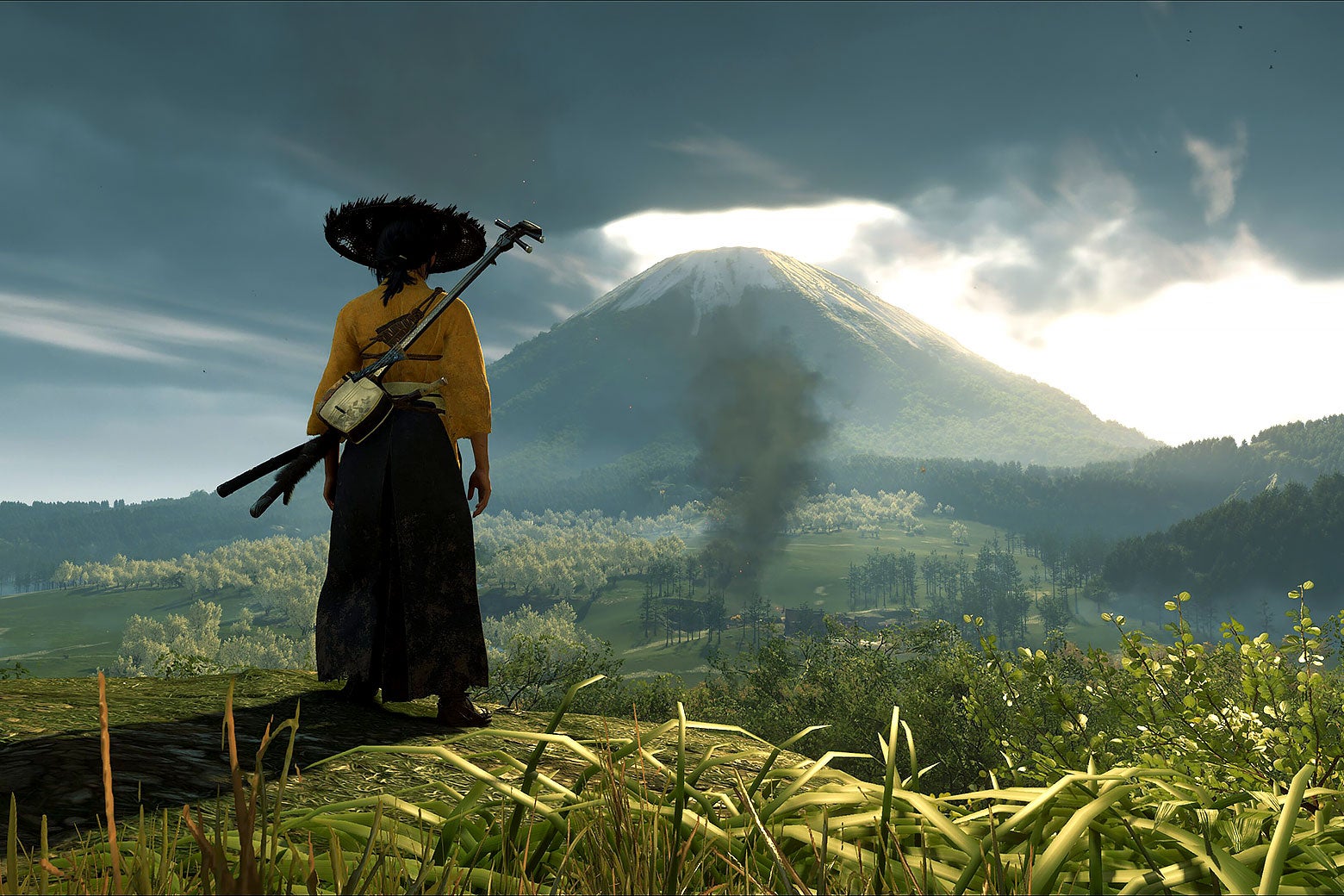
Ghost of Tsushima’s tale of a male samurai’s solitary quest for revenge was heralded as the epitome of what gaming could be. Fast-forward to October 2025, and we see the release of its sequel, Ghost of Yotei. Set 300 years after Tsushima, Yotei follows the story of Atsu, a young woman on a quest for revenge against the six people responsible for slaughtering her family. Driven by fury and bloodlust, she embodies the identity of an onryō, a vengeful female spirit said to be unstoppable in its quest for revenge on the living.
Ghost of Yotei is, at its core, a very similar game to Ghost of Tsushima, offering more combat tools for players but largely a mechanically similar adventure with what I’d argue is a more personally engaging main character. Atsu’s quest for vengeance has more nuance to the twists and turns it takes along its way.
Now the very same right-wing voices who held Ghost of Tsushima up as one of the best games ever made when it helped their argument seem to think Ghost of Yotei is a terrible video game with no redeeming qualities. YouTube creators decried how “WOKE politics” ruined the game, while others took to X to decry its “progressive agenda.” “We ignored the woke hirings and other rumors,” Mark Kern, a former video game executive and prominent Gamergate activist who goes by Grummz online, wrote on X. “We ignored the protagonist change to a woman for no good reason. We ignored that they made her ugly. … But then it turns out, it was a woke infested, assassination loving, Antifa supporting, lesbian ending woke piece of slop after all.”
Many of the core of the arguments boil down to “I don’t believe a woman could murder a strong and combat-trained man.” Regardless of their justifications, I think it’s pretty clear the difference that they’re upset about is that this time the main character is a woman, played by a nonbinary actor. Erika Ishii, the Japanese American actor for Atsu who provided the character’s English voice-acting, does an incredible job voicing Ghost of Yotei’s vengeful lead. Their performance captures a lot of subtle complexity as the character wrestles with the costs of vengeance, and tries to imagine life once that motivating quest has ended. Outside of their acting performance, Ishii is outspokenly antifascist. Ever since their involvement in the game was announced, those in the online right have been salivating for their chance to pounce.
This isn’t the first time this kind of attitude has followed Ishii’s attachment to a game; last year, they were one of the voice options for Rook, the lead character in Dragon Age: The Veilguard. That game was targeted with similar hate aimed at Ishii, as well as anyone else noncisgender involved in the game in any capacity.
That game allowed the player to optionally have their character be transgender, and featured a party member who came out as nonbinary during the course of the adventure. I know firsthand how ravenous people were with that game’s release: I posted online that I’d worked on the game without any specifics and was very quickly targeted with abuse ranging from exaggerated transphobic caricatures to violent punishment-fantasy emails to disturbing content being spammed in my livestream chats. In their minds, as a trans woman credited on the game, I obviously must have singlehandedly forced Bioware to make the game woke against their will. It was quite a thing to watch right-wing gamers stream Veilguard, pick three dialogue choices about being trans in a row, then act with mock outrage that the game had “forced” them to now be transgender.
As with Ghost of Yotei, you can see how flimsy these arguments are if you look at them for more than a moment. And the thing is, I wish we could just ignore this vocal but small minority of bigoted creeps, but their hate campaigns are unfortunately having real impacts on the kinds of games we are seeing get made.
As reported this past week by Stephen Totilo at Game File, Ubisoft last year canceled development of an Assassin’s Creed game set in the post–Civil War United States, where players would have played a Black former slave fighting against the early formation of the KKK. The game was reportedly canceled due to “concerns over the political climate in the States,” but also in part due to vocal right-wing backlash against Yasuke, a Black samurai character playable in Assassin’s Creed Shadows.
Video game executives are unfortunately listening to this vocal minority of right-wing voices and allowing them to make boardrooms shy away from progressive themes. Many of these ideas are barely progressive—it’s hardly a dramatic move for a game to feature a female character who is older or doesn’t fit specific beauty standards, but that’s the point. If these movements can wrap anything big or small into these reactionary culture wars and make enough noise, they can make anything but a cis, straight, able-bodied male protagonist feel like an inherently political creative choice. Having your game’s hero be a woman who can fight, or casting a nonbinary actor because they were the best fit for the role, should not be considered any more political a choice than having a white man play a white male lead character.
This issue of right-wing men attacking minority creatives and characters in video games has been going on for well over a decade at this point, and is unlikely to fade away any time soon. Until then, I’m just going to be equally vocal when I love something, and scream in all-caps how happy I am about who I get to play as, and how much I love specific casting choices. If these angry gamer boys can shout loud enough to redirect the direction of game development, I have to hope I can do the same in reverse.