



Before he stepped into the batter’s box in Detroit for his last at-bat on the final day of the 2000 Major League Baseball season, Minnesota Twins infielder Denny Hocking had done the math.
All spring and summer, Hocking’s batting average had hovered above or just below the magical mark of .300, an average he had never reached in his seven previous big-league seasons. It wasn’t some obscure statistic. Baseball is defined by numbers, yet few have resonated quite like the challenge of getting three base hits out of every 10 at-bats.
“From the time baseball began, a .300 average has been the benchmark by which a player’s success at the plate has been judged,” Charley Lau, a longtime MLB hitting coach, wrote in his 1980 book, “The Art of Hitting .300.” It was, Lau said, “the traditionally accepted mark of excellence,” so much so that longtime New York Yankees great Don Mattingly wrote a book about hitting .300, too.
In the film “Bull Durham,” the character played by Kevin Costner refers to hitting .300 as the type of feat that could lift a player out of the minor leagues and into Yankee Stadium. Averaging .300 for your career can lift you into the Hall of Fame, in fact; the career average for every enshrined hitter is .303.
And .300 was on Hocking’s mind as he entered Oct. 1, 2000, with a .296 average. By the time he stepped to the plate in the top of the ninth inning, he had 111 hits in 372 at-bats and understood that with one more hit, he’d join the 53 other big-leaguers that season who hit .300 or better.
“I freaking lined out,” Hocking said. “I was like, ‘That sucks.’”
In the quarter-century since then, fewer and fewer players have gone into the season’s final day anywhere close to a shot at hitting .300 for the season, however, as the allure of reaching the mark has dimmed.
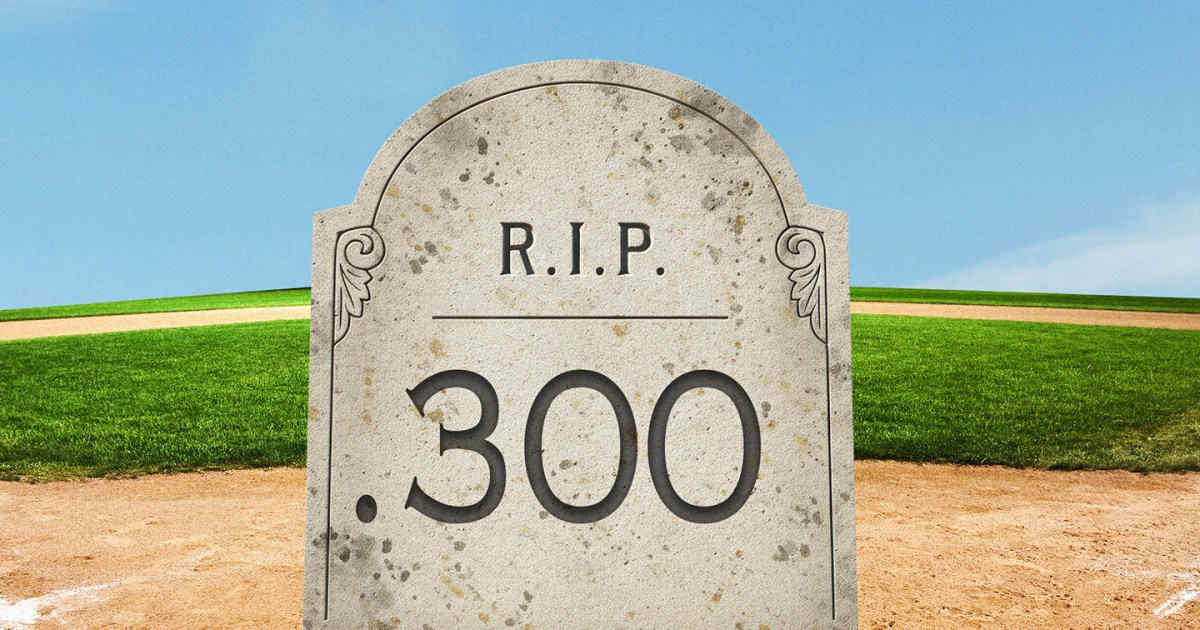
By 2005, the ranks of .300 hitters had dipped to 33. By 2014, when there were only 17, it prompted media coverage asking whether the death of the .300 hitter was close. Not quite — but last rites were being prepared.
This season, and for the second consecutive year, only seven qualified players hit .300 or better, the fewest since there were six in 1968. Philadelphia’s Trea Turner led the National League with a .304 average this season — the second lowest ever by a batting champion.
The dip has coincided with a general decrease in overall averages. From 1973 to 2017, the average batting average in MLB never dipped below .250, but in eight seasons since then, it has happened seven times.
“In terms of putting the ball in play, you have a much lower chance than any point in baseball history at getting a base hit than you ever have before,” said Jacob Pomrenke, the director of editorial content for the Society for American Baseball Research.
“The idea that hitters are not as good as in the past, I don’t think it’s true. But pitching, we know for a fact it’s just worlds better than it was even 10 years ago.”
Teams still value prospects who get on base, don’t strike out and hit with hard contact as much as ever, said a senior executive who oversees scouting for an MLB team who wasn’t permitted to speak publicly. Yet unlike in the past, when using the hit-and-run or bunting were common ways to manufacture runs and prospects who lacked muscle were allowed to grow into their power as they aged, the executive described an increasing emphasis on hitting for power — one that has been pushed downstream on younger prospects, regardless of their frames.
“Now it’s just more walking, hitting home runs and striking out,” the executive said. “The approach to the game and the approach for a lot of the hitters has changed. The guys that are getting paid are the guys that are hitting a lot of the home runs, even though they might be hitting .220.”
Pomrenke called that emphasis a rational response to what hitters are seeing on the mound.
Pitch velocities have sped up by nearly 6% percent since 2002, one analysis found. When San Diego Padres closer Mason Miller threw a pitch 104.5 mph this month, it was the fastest pitch thrown in the postseason since pitch-tracking first started in 2015. Medical advances have also allowed pitchers who injure ligaments in their throwing arms, including those who have the once-feared and career-ending “Tommy John” surgery, to perform often even more effectively after having gone under the knife. Many pitchers have gone on to win the Cy Young Award, given to the league’s top pitchers, post-surgery.
“It’s become an expected thing that they come back from it,” Dr. Neal ElAttrache, one of the most in-demand surgeons in professional sports, told the Los Angeles Times in January. “I think it would be a bigger story now if one of these guys, a big-time athlete, has an operation and doesn’t make it back. That would be big news.”
That has given pitchers incentives to throw harder by lowering the consequences of doing so. Hitters “correctly understand that trying to get three hits in a row is very, very difficult against most pitchers,” Pomrenke said. “So they’d rather swing for the fences. They’d rather try to hit a home run because that’s the way they can succeed best. Their odds are greater.”
Where hitting finds itself isn’t solely a modern issue. Hitters and pitchers have ebbed and flowed before; after it hit historic offensive lows in 1968, MLB took the step of lowering the pitching mound and adjusting the strike zone. Babe Ruth is considered the first player to recognize the damage that can be done with one swing; he also struck out at a legendary rate. The legendary hitter Ted Williams, the last to hit. 400, wrote in his 1971 book, “The Science of Hitting,” that batters could increase their chances of contact by swinging at an upward angle.
Yet the ranks of the .300 hitters aren’t expected to grow in coming years. A technology boom allows high-speed cameras to instantly track and communicate information about a batter’s swing plane and the launch angle and velocity of a batted ball. The importance of the .300 threshold came out of an era when calculating power was limited, Pomrenke said; now, advanced statistics popularized by the early 2000s Oakland A’s of “Moneyball” fame have placed an emphasis on better, more specific measurements.
Even Lau, in his 1980 book, acknowledged that batting average alone was limited in capturing the scope of a hitter’s value, proposing a statistic that would “recognize the value of consistency by pegging it to its major result: advancing the runner.”
Yet when Lau opined that “if you [try for home runs] every at-bat, you’re almost sure to ruin your average and destroy your chances for hitting consistency, which can significantly reduce your value to the team,” he was only half right. It will drive down your batting average but also drive up your value.
When free agency begins this winter, Luis Arráez, the San Diego infielder who hit .314 or better in 2022, 2023 and 2024, is expected to command far less than Kyle Schwarber, the Philadelphia slugger who hit .240 but led the National League with 56 home runs.
Schwarber left college in 2014 with batting averages regularly above .350, but he has remade himself to fit the modern boom-or-bust mold; his 197 strikeouts were third most in all of baseball this season. The executive who helped oversee a team’s scouting said scouts would have a much tougher time advocating for a team to draft high school prospects Shawn Green or Cody Bellinger, who rarely hit home runs in high school, only to gradually work up their power.
One poster child for baseball’s hitting evolution over the past quarter-century is Justin Turner. A seventh-round pick in 2006, he had had eight career home runs and had become a journeyman by the summer of 2013.
That year, Turner began to rebuild his swing under the advice of a teammate, Marlon Byrd, and a hitting coach in Southern California, Doug Latta. Since 2015, including an injury-shortened season, he has become a lineup mainstay while averaging nearly 17 home runs per season.
“I was getting base hits but not slugging — and in this game you’ve got to slug to stick around,” Turner said in 2018.
A .300 batting average still holds currency for some as a generally accepted mark of a good hitter.
“I like average. I know that stat has gone away, but I’m like, if you play every day and you hit .300, that’s probably meaning you’re getting about 170 to 175 hits, plus you’re walking, so you’re on base quite a bit,” Dodgers first baseman Freddie Freeman said this spring.
Freeman might be an outlier, however.
After Hocking retired in 2005, he operated a hitting academy and eventually managed in Seattle’s minor-league system, and he helped catcher Cal Raleigh develop the power that this season produced an MLB-leading 60 home runs. Top Mariners brass considered batting average a “luck stat,” he said. Instead, the team created an organization-wide, March Madness-style bracket in which hitters from both the majors and the minors could advance by who made the better “swing decisions” — how much a hitter swung when a ball was in the strike zone, versus out.
The prize for the bracket’s winner, Hocking said, was considerable — an invitation to next season’s spring training.