






New York
—
To the lawmakers in Congress who seem to be stuck on Reagan-era myths about the people who rely on food stamps, here’s an idea: Let’s reframe the idea of the Supplemental Nutrition Assistance Program, or SNAP.
Don’t think of it as food stamps — think of it as a vital tool in a pro-business agenda.
Hear me out.
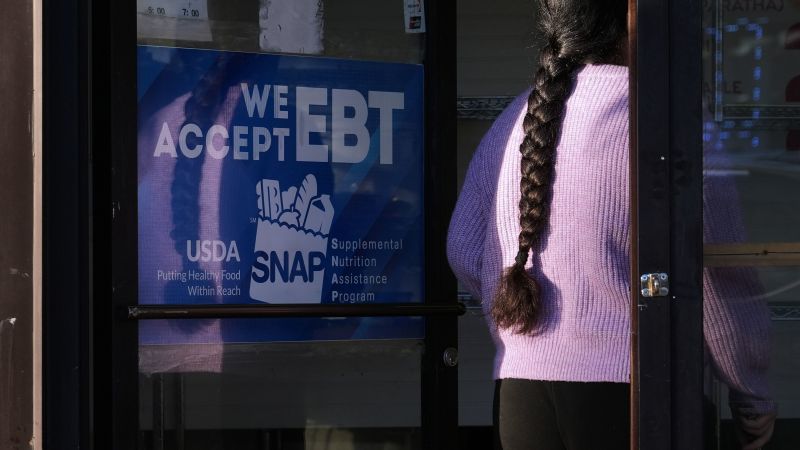
If the prospect of people going hungry doesn’t move you, consider some of the other beneficiaries of SNAP. Like Walmart, Amazon, McDonald’s and other titans of Corporate America whose profits rely on workers who are paid low wages – such low wages that without SNAP, they couldn’t afford food.
Yes, it’s that shameful tinge of social welfare that American capitalists don’t generally want to talk about. Nonetheless, some of the biggest and most profitable American corporate icons pay their employees poverty-level wages while counting on those workers not to collapse from caloric deficits because they’re receiving food stamps.
Nearly 42 million Americans rely on SNAP, which, as of this weekend, will be only partially funded by the Trump administration for the month — happy Thanksgiving, America! — while the government is shut down. To some lawmakers and pundits on the right, the run-up to the November 1 funding cliff was a moment to shame those people, nearly 40% of whom are children and 20% elderly, according government data.
Congressman Clay Higgins of Louisiana chided SNAP recipients on X last week, writing that if families haven’t been smart enough to stockpile a month’s worth of food they should “never again receive SNAP, because wow, stop smoking crack.” Alabama Sen. Tommy Tuberville complained that there are “a lot of young men on SNAP that should be working.” (Just to note, 70% of people who rely on federal programs like SNAP do work full-time, per government data.)
Lawyer and MAGA pundit Mike Davis, not to be outdone, said on X that SNAP recipients should “get off your fat, ghetto asses,” and “stop reproducing.”
Just for brevity’s sake, let’s ignore the immorality of relishing other people’s hunger to score political points. What the Higginses and Davises of the world are not getting is that SNAP is good for business, and not just because it keeps workers, like, alive.
Let’s take Walmart, for example.
Walmart, America’s largest employer, gets a double-dip of the food assistance program. The first dip comes from keeping labor costs so low that many of its own employees rely on SNAP to survive. Then, Walmart gets another bottom-line boost, as a large portion of those SNAP funds get turned around and spent at Walmart.
A quarter of all the SNAP shopping in America happens at Walmart, with an additional 4% happening at Walmart-owned Sam’s Club, according to a report by market research group Numerator. That is largely to Walmart’s credit: It was the first retailer to accept SNAP online in all 50 states, starting in 2023. And Walmart’s incredible scale also allows it to undercut the competition on pricing, which, naturally, attracts customers on a budget.
At the same time, a 2020 study from the nonpartisan Government Accountability Office found that Walmart was among the top four employers of SNAP and Medicaid beneficiaries in all 11 states surveyed. Other major employers named in the study include McDonald’s, Dollar Tree, Dollar General, Amazon, Burger King and FedEx.
Walmart didn’t return CNN’s request for comment Tuesday. In response to the GAO study, Walmart told the Washington Post that the numbers of employees using SNAP and Medicaid were in proportion to Walmart’s scale, and that absent its business “many more people would be dependent on government assistance.”
Walmart’s wages for frontline associates average about $18 an hour, according to its website — more than double the federal minimum wage of $7.25, which hasn’t been raised since 2009. Walmart has also publicly advocated for Congress to raise the federal minimum wage and promotes career advancement programs for its staff.
That’s still not enough to survive without government aid in many places.
Bottom line: The people attempting to villainize SNAP recipients seem to forget that those people help everyone else shop and eat at restaurants and engage in any number of ways with our consumer-driven economy. And the recipients aren’t just people — they’re corporations, too.